
Appearance
License Validation
CE Broker checks each license number while the learner is registering. Here's what that looks like, and what to tell a learner whose valid license is rejected.
Validation happens at registration
Once CE Broker is configured, LecturePanda sends the learner's license number to CE Broker during registration and asks whether it's valid. If it isn't, the registration form says so on the spot and the learner corrects it before signing up.
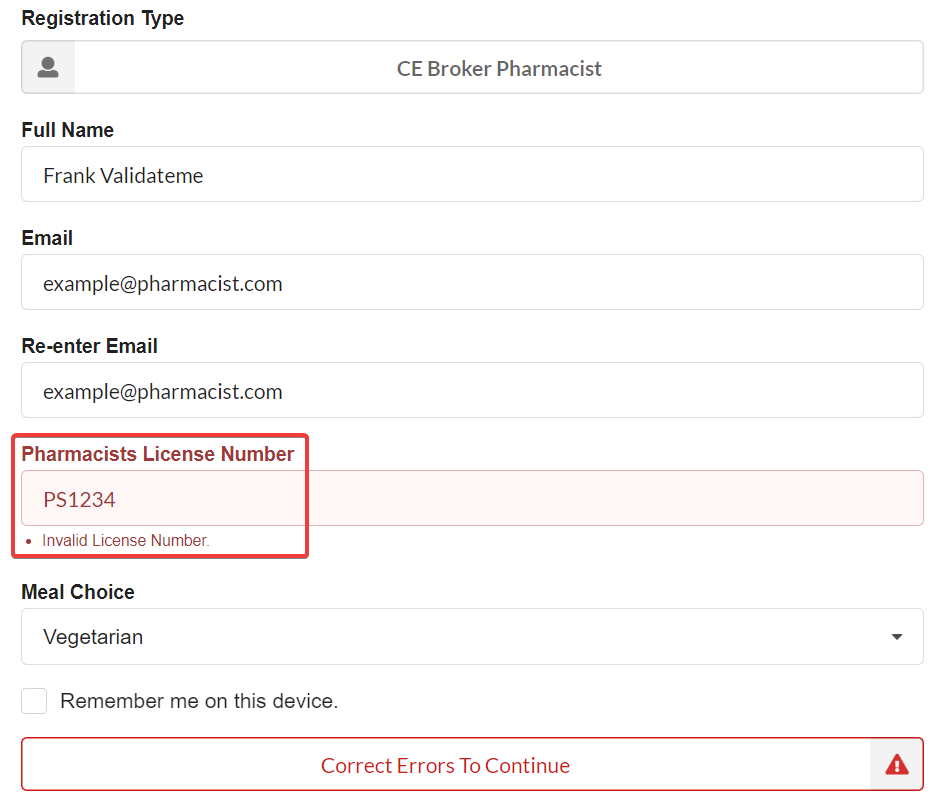
Catching it here is the whole point. A bad license number found at registration costs the learner ten seconds; the same number found in a rejected upload months later costs you a support thread, a resubmission, and a learner whose credit is late.
"Invalid license number" on a license that really is valid
A learner insists their license is active — and checking the state portal confirms it — but registration still rejects it.
The message is coming from CE Broker, not LecturePanda. We pass the number along and report back what CE Broker says.
The usual cause: the learner has a valid state license but no CE Broker account with that license registered to it. Holding the license isn't enough on its own; CE Broker needs an account tied to the license before validation passes.
What to tell the learner:
- Create a CE Broker account, if they don't already have one
- Make sure their license number is added to that account
- Try registering again
Heading off the question
Providers who see this often add a line to the course announcement: a CE Broker account with your license attached is needed to register. It converts a support email into a step the learner takes on their own.
Multi-state licensees
States use CE Broker differently, and LecturePanda reports automatically to every board on your configuration — validated at registration, submitted on completion, hands-off in between.
Learners licensed with a board outside that set submit to their own board directly, using the certificate their completion produces. This comes up most in states with a lot of compact and transferred licenses.
Set expectations on the course itself
Many providers add a note on the credits step spelling this out — for example, that multi-state licensees may need to self-report to their other boards. An instructions section on the course puts it in front of learners before they claim.